
The net-zero conversation in India has largely centred on energy, solar panels, efficient HVAC, and building automation. These are essential. But two dimensions of net-zero performance remain systematically underaddressed: water and materials. In a country where major cities face acute water stress and the construction sector generates an estimated 150 million tonnes of waste annually, the path to truly net-zero buildings cannot ignore these resource streams.
This blog addresses the circular dimension of net-zero performance smart water management, low-carbon materials, and construction practices that treat waste as a resource rather than a liability.
Water: The Overlooked Dimension of Net-Zero
Water and energy are deeply intertwined in buildings. Heating water accounts for a significant share of residential energy consumption, while pumping water consumes substantial electricity at both the building and city scale. Yet water efficiency is frequently treated as an afterthought in net-zero discussions.
Smart Water Metering and Monitoring
One of the most impactful and most underutilised tools available to Indian RWAs today is real-time water metering. Smart water meters with IoT connectivity allow building managers to monitor consumption at the unit level, detect leaks instantly, identify high-consumption patterns, and benchmark usage across the complex. Studies consistently show that buildings with real-time water monitoring reduce consumption by 15–30% simply through visibility and feedback [1].
In India, where many apartment complexes still rely on manual meter readings and monthly summaries, the shift to continuous digital monitoring represents a step-change in resource management. The technology exists and is being deployed in premium residential and commercial buildings today.
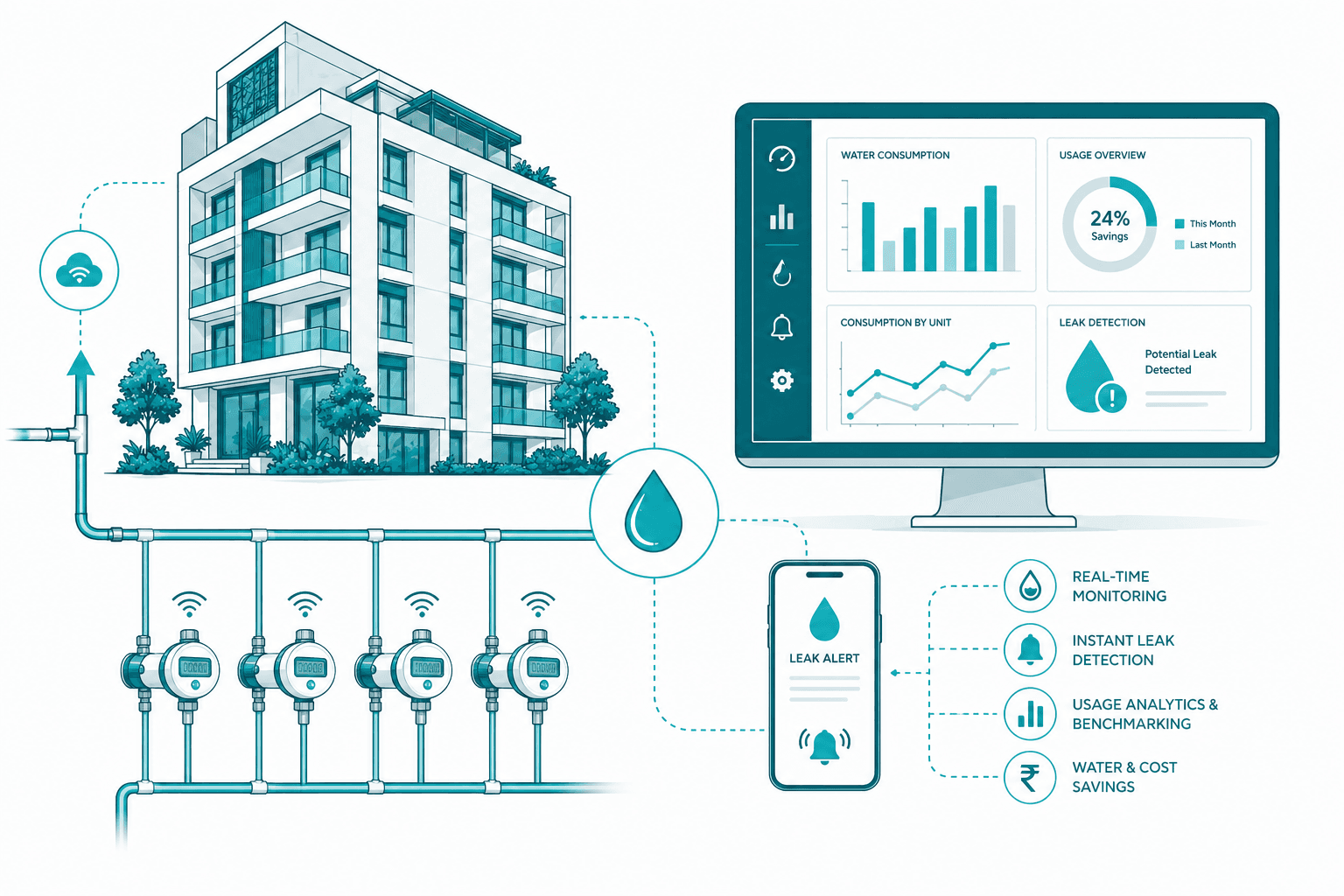
A leading example of this in India is WEGoT - an IoT-enabled ultrasonic smart water metering system that provides unit-level consumption monitoring, real-time leak detection, and AI-enabled alerts through a central dashboard, with over 6 billion litres of water saved across 65,000+ homes and 50 million sq.ft of commercial space across India.
Integrated Water Management
At the building scale, Integrated Water Management (IWM) treats water as a resource to be cycled rather than a waste to be discharged. This includes rainwater harvesting, dual-flush and low-flow fixtures, water-efficient appliances, drip irrigation for landscaping, and critically on-site treatment and reuse of greywater and blackwater.
This is where net-zero sewage treatment technology becomes transformative. Compact, decentralised sewage treatment systems designed specifically for apartment complexes and commercial buildings can treat 100% of wastewater on-site to reusable standards, eliminating dependence on municipal sewage infrastructure while recovering water for irrigation and flushing. For Indian buildings in water-scarce cities, this is not merely a sustainability measure it is an operational necessity. Such systems are now commercially available and being deployed in Indian residential and mixed-use developments.
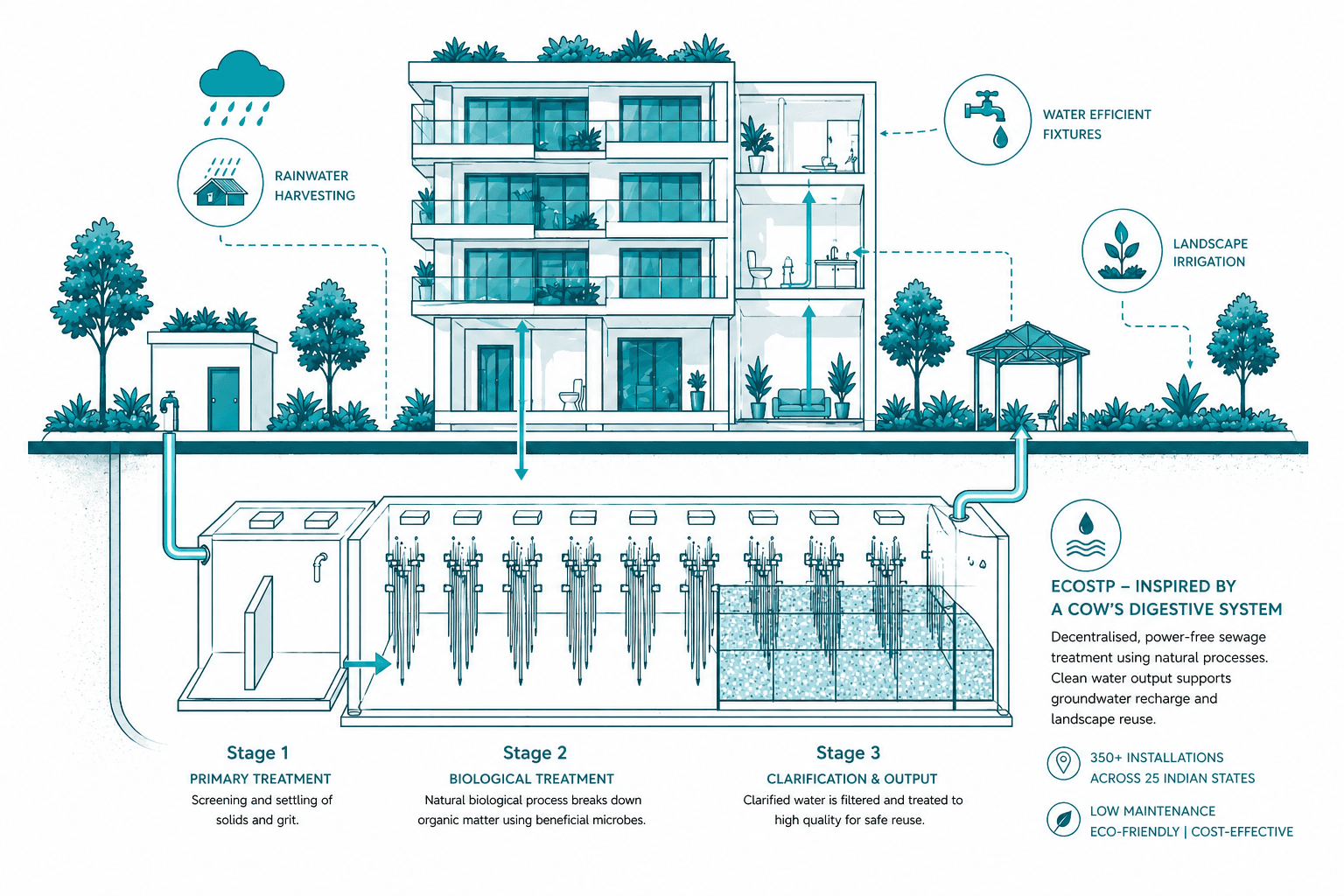
This is precisely where innovations like ECOSTP are making a difference - a net-zero sewage treatment technology inspired by the microbial ecosystem of a cow's digestive system, with patented underground treatment chambers that require no power, chemicals, or human intervention, now deployed across 350+ installations in 25 Indian states.
Sustainable Materials: Closing the Embodied Carbon Loop
Operational efficiency addresses the energy and water consumed while a building is in use. But embodied carbon the emissions generated during the production and transport of building materials accounts for an increasingly significant share of a building's lifetime impact. As operational carbon falls through efficiency measures, embodied carbon becomes proportionally more important.
Low-Carbon and Carbon-Negative Materials
A new generation of building materials is emerging that either significantly reduces embodied carbon or actively sequesters it. These include bamboo, hempcrete, mycelium insulation, biochar, cross-laminated timber, and bio-based polymers. At scale, these materials shift construction from a carbon-emitting process toward a carbon-neutral or even carbon-positive one [2].
Construction Waste as a Resource
India generates an estimated 150 million tonnes of construction and demolition waste annually most of which is landfilled or dumped illegally. Innovative materials companies are now converting this waste along with post-consumer plastics into structural bricks and construction blocks that meet building code requirements while diverting waste from landfill.
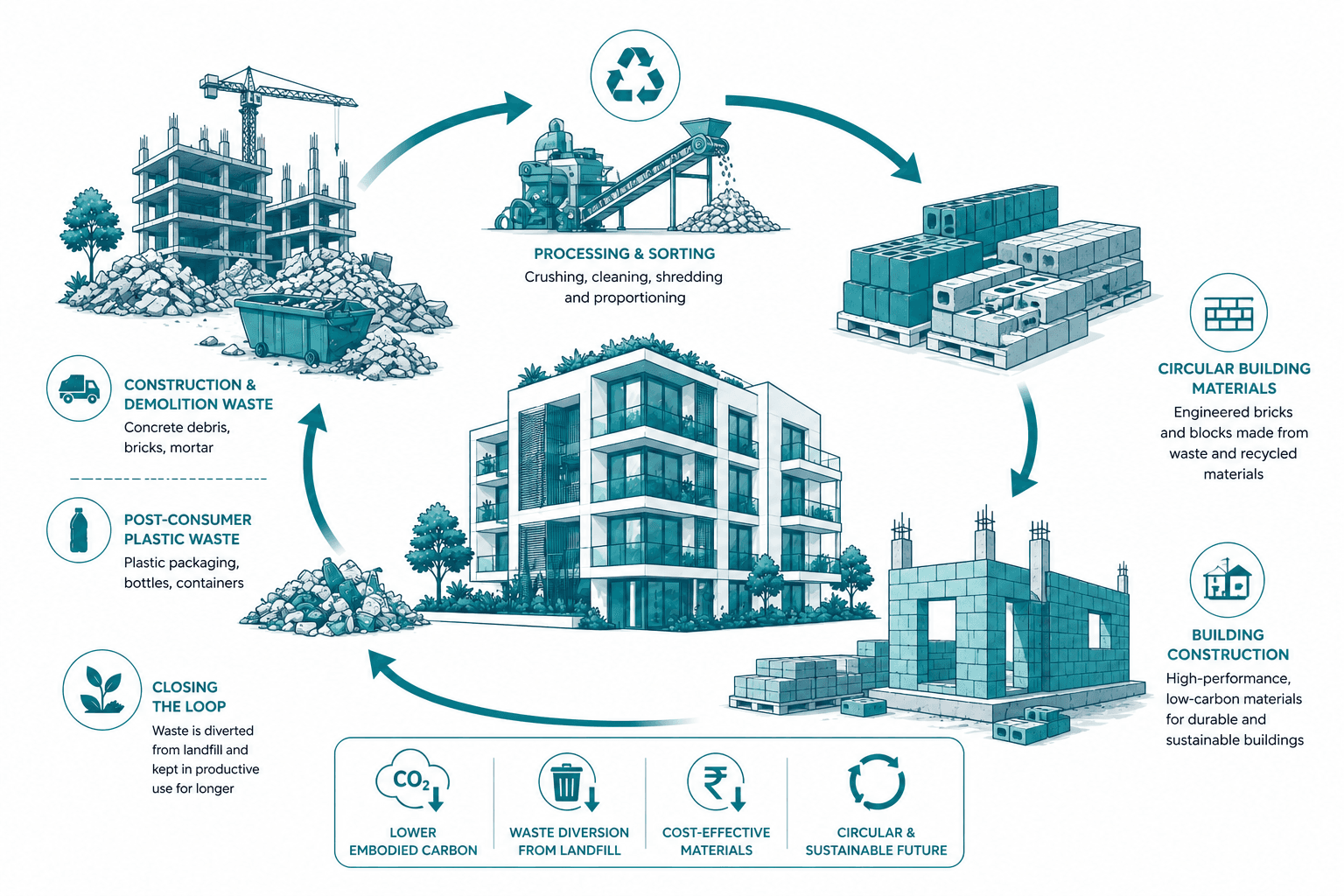
The implications are significant: a building project that sources its bricks from construction waste effectively embeds circularity into its material supply chain. The carbon footprint of manufacturing is dramatically lower than that of conventional fired bricks, and the waste diversion impact is measurable. This technology is available in India today and is being used in residential and commercial construction projects.
This is where innovations like Wricks by Angirus become significant - bricks manufactured entirely from recycled plastic and construction and demolition waste, that are 30% lighter, 20% stronger, and 80% more waterproof than conventional clay bricks, actively being used in residential and commercial projects across India today.
Advanced Construction Techniques
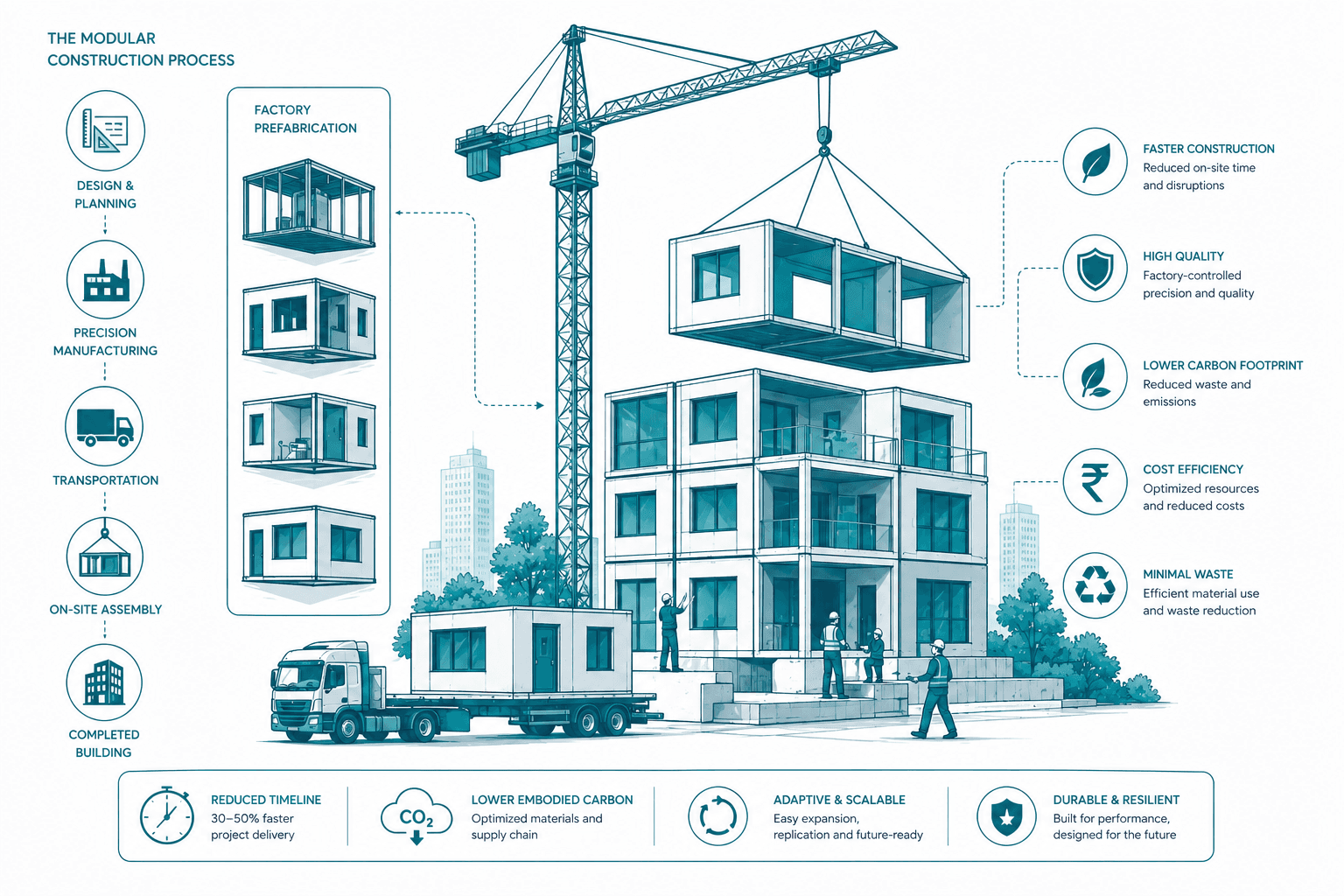
Prefabrication, modular construction, and Industrialised Building Systems (IBS) reduce on-site waste, improve quality control, and accelerate delivery. For net-zero projects, precision manufacturing also means better airtightness and thermal performance outcomes that are difficult to achieve consistently with traditional site-based construction.
The Indian Opportunity: Why Now
Water scarcity is no longer a future risk for Indian cities it is a present operational reality. At the same time, the construction sector's waste problem is growing faster than the infrastructure to manage it. Buildings that address both dimensions through smart water management and circular material sourcing are not just environmentally responsible. They are operationally resilient in ways that conventionally designed buildings simply are not.
The solutions exist, are commercially available, and are being deployed in Indian projects today. The opportunity is to move from isolated interventions to an integrated approach that measures, manages, and optimises water and material performance alongside energy as part of a single resource intelligence framework.
The future of Indian construction is not just about building more it is about building better. Water efficiency and material circularity are not constraints on development; they are the foundations of buildings that remain valuable, resilient, and cost-effective over decades. Every litre of water recycled on-site, every tonne of construction waste converted into a structural brick, and every kilogram of embodied carbon avoided is a measurable step toward a built environment that genuinely works within planetary boundaries.
This journey begins with asking better questions not just how much energy does this building use, but where does the water go, what is in these walls, and what happens to this building at the end of its life.
Image Disclaimer: All images used in this article are for illustrative and educational purposes only. They represent concepts, design approaches, and system relationships. Actual project designs, configurations, and performance outcomes may vary based on site conditions and implementation practices.
References
- WEGoT Utility Solutions internal data and published case studies on IoT-based water metering in Indian residential complexes.
- Kharissova, A. B. et al. (2024). Carbon negative footprint materials: A review. Nano-Structures & Nano-Objects, 37, 101100.