
Net-zero buildings don't run on good design alone. Once a building is constructed, its actual energy performance depends almost entirely on how efficiently its systems operate and how intelligently they are managed. In India, where electricity tariffs are rising steadily, grid reliability varies across states, and cooling demand is intensifying with urban heat, energy performance is not a design-time decision. It is an ongoing operational discipline.
This blog focuses on the technologies and platforms that reduce energy demand, store and manage renewable generation, and create the digital intelligence layer that keeps a building performing at its designed potential day after day, across changing seasons and occupancy patterns.
Energy Efficiency: From Grid to End Use
Net-zero isn't only about generation it's equally about reducing demand. Energy efficiency in operates across the entire supply chain: from grid-side renewable sourcing and smart transmission through to on-site systems and occupant behaviour.
Key efficiency technologies include:
High-efficiency HVAC equipments
Chiller Plants, VRF systems, AHUs etc.
Energy and Heat Recovery Ventilation
ERV and HRV systems recover energy from exhausted air to precondition incoming fresh air.
AI-driven Building Automation Systems
BAS platforms that learn usage patterns and self-optimise in real-time.
Demand-Control Ventilation
DCV automatically adjusts airflow based on actual occupancy levels.
EC Fans and VFDs
Electronically Commutated Fans and Variable Frequency Drives adjust motor speed to real-time demand, reducing energy consumption significantly.
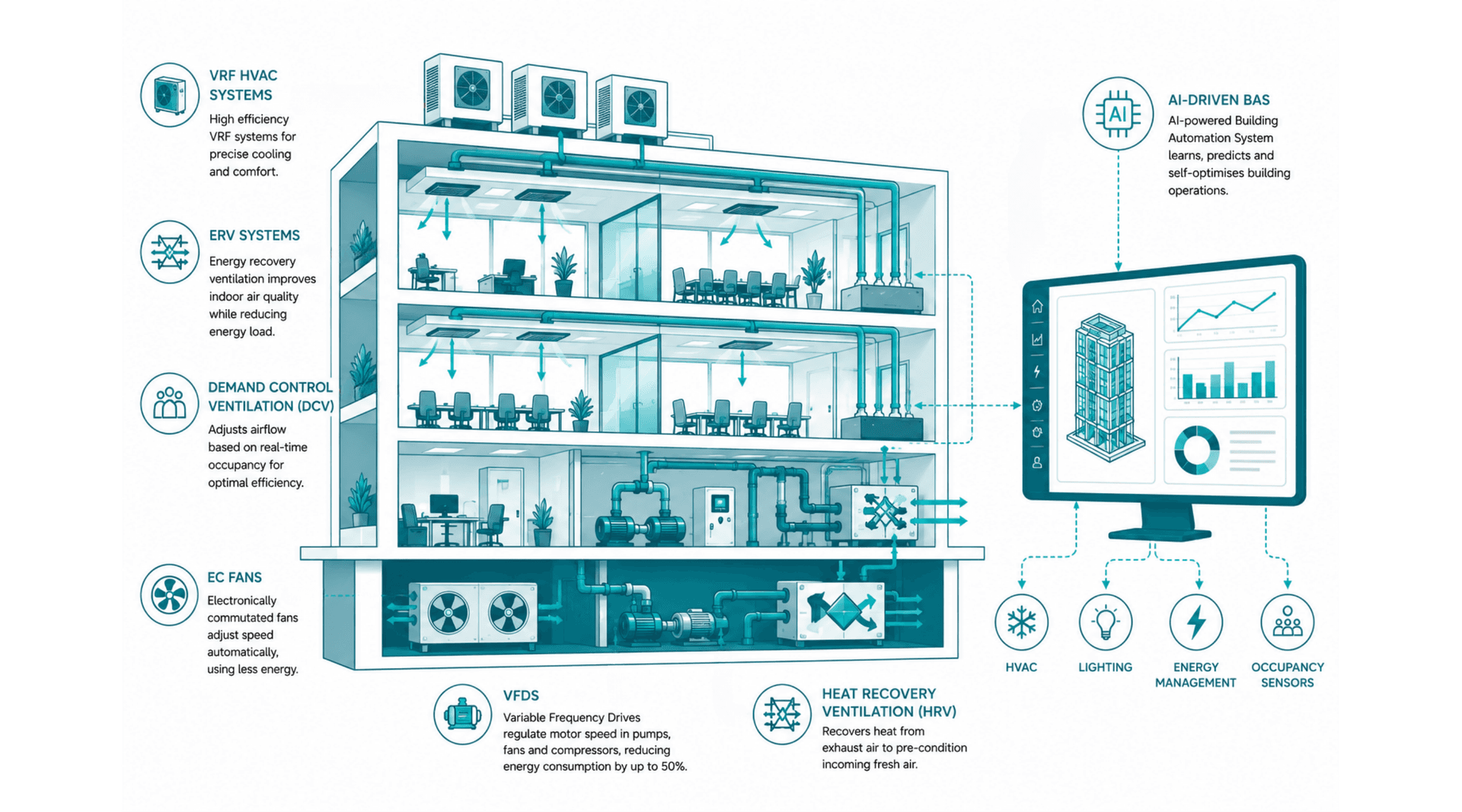
When VRF systems are coupled with ERVs and AI-driven BAS platforms, energy savings exceeding 35% over conventional systems have been demonstrated in studies of commercial buildings [1].
This is precisely where professional energy auditing and retrofit services play a critical role. In India, specialised firms now offer end-to-end energy efficiency consulting baseline assessments, system upgrades, and ongoing monitoring helping existing buildings close the gap toward net-zero performance without requiring a complete rebuild. The most effective interventions combine technology upgrades with operational changes, guided by real data.
Smart Energy Storage and Grid Integration
Battery Energy Storage Systems (BESS)
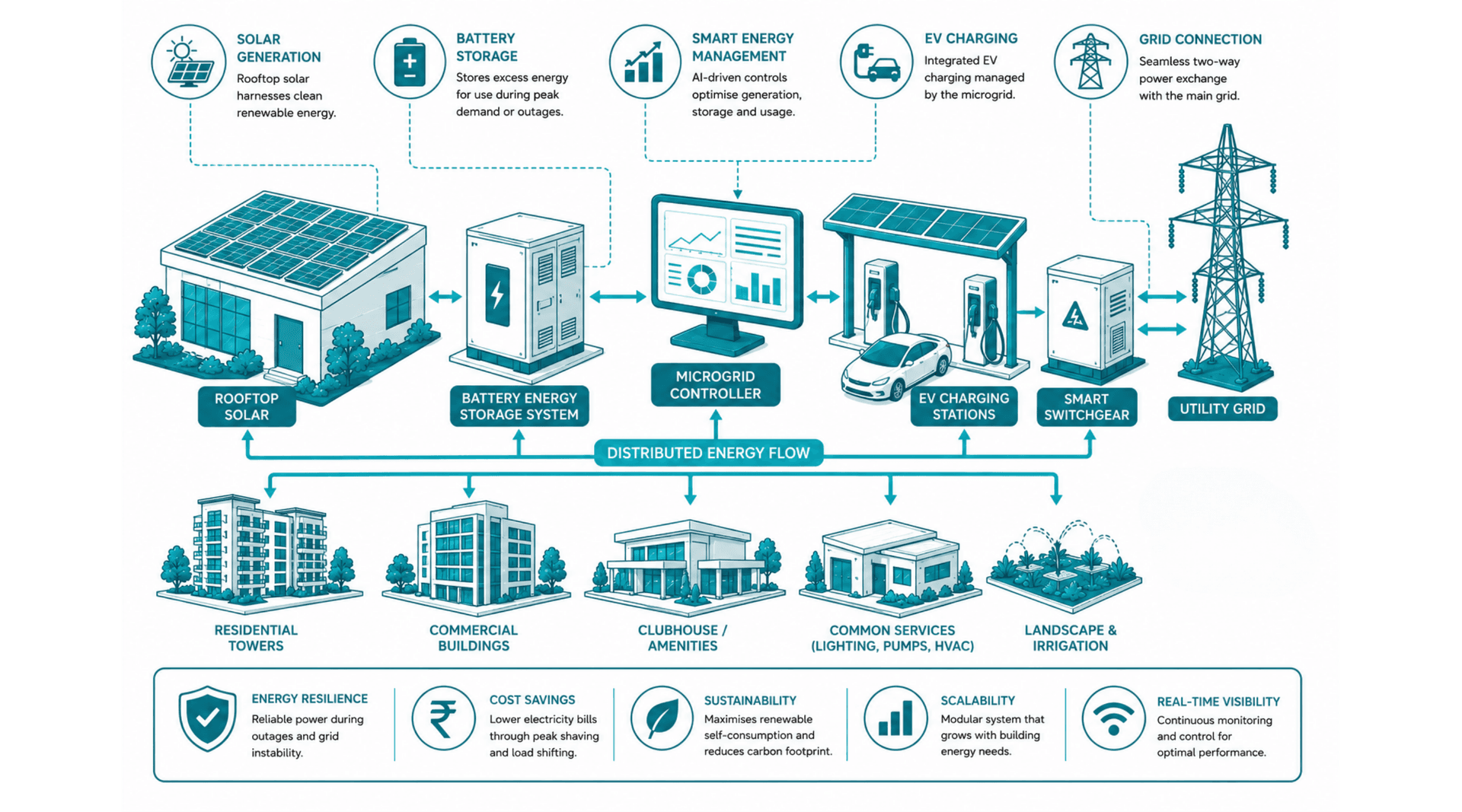
Renewable generation is intermittent. BESS essentially large-scale power banks for buildings bridge the gap between when energy is generated and when it is consumed. For Indian buildings dealing with grid instability and peak-tariff electricity pricing, BESS offers a compelling combination of resilience and cost savings. Key functions include maximising solar self-consumption, load shifting to avoid peak tariffs, and providing backup power during outages.
Microgrids and Smart Grid Integration
At the community level, smart microgrids integrate distributed energy resources rooftop solar, BESS, EV charging into a unified network that can operate independently or in coordination with the main grid. For large RWA complexes and commercial parks, a well-designed microgrid can significantly reduce dependence on grid power while improving energy resilience.
Digital Intelligence: The operating system of sustainable and smart buildings
Building Management Systems (BMS) and AI
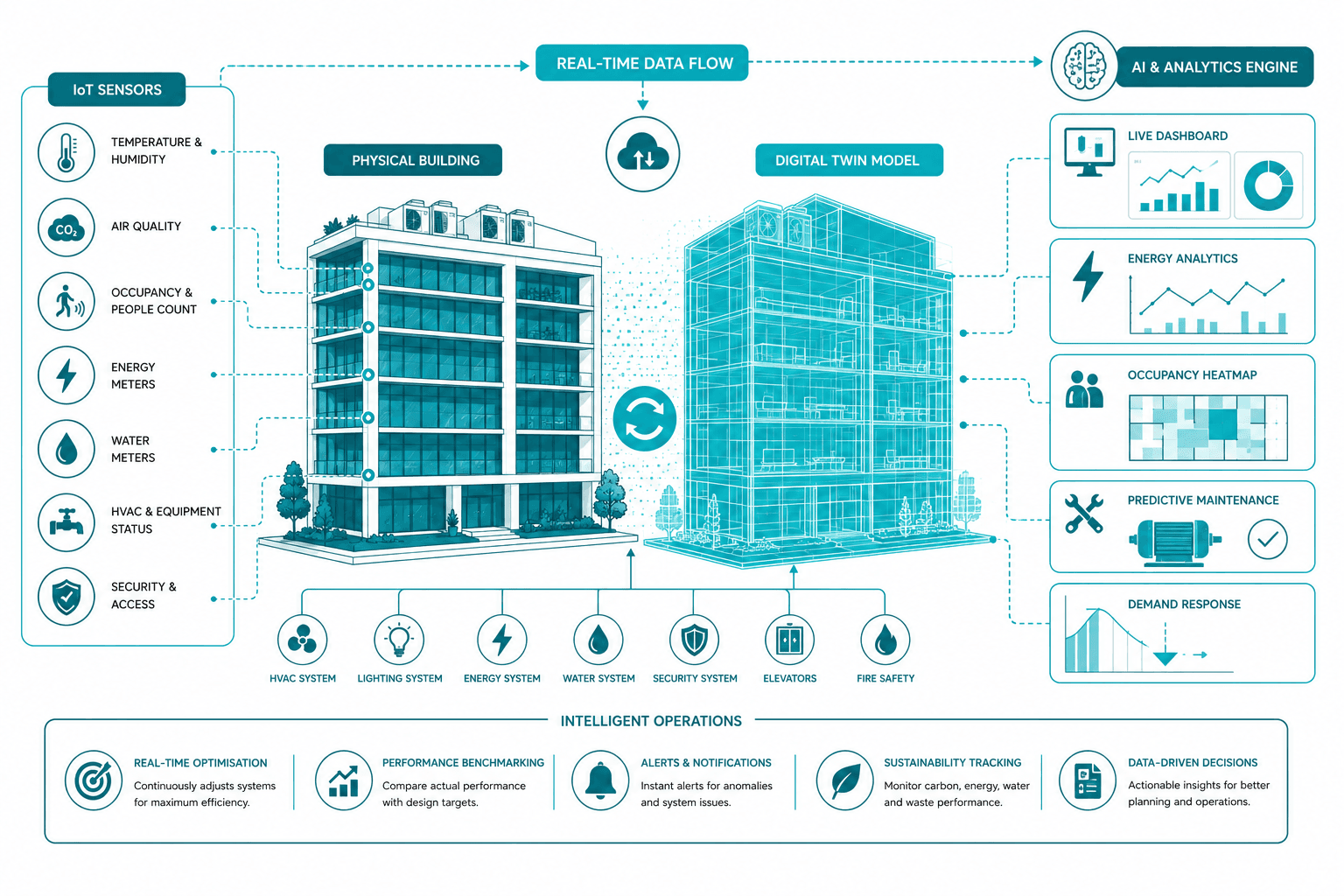
A Building Management System (BMS) also called a Building Automation and Control System (BACS) is the central nervous system of a building. It integrates sensors, actuators, HVAC controls, lighting, security, and energy systems into a unified platform, using predictive analytics, IoT data, and increasingly AI to optimise performance in real time.
Modern BMS platforms use fuzzy logic controllers to manage the non-linear dynamics of HVAC systems, machine learning to predict occupancy and weather patterns, and automated demand response to shift loads away from peak periods. The result is a building that continuously self-optimises not just at commissioning, but throughout its operational life.
Digital Twin Technology
Digital twins virtual replicas of physical buildings that simulate behaviour in real time are becoming a standard tool for high-performance building management. By integrating IoT sensor streams, energy models, and occupancy data, digital twins enable operators to test interventions virtually before implementation, predict maintenance needs, and continuously benchmark performance against design targets [2]. Several global and Indian technology companies are developing digital twin platforms specifically for enabling a new class of data-driven building operation that was simply not possible a decade ago.
Real-Time Resource Intelligence
At the household and unit level, the translation of building-scale intelligence into actionable insights for residents and RWA managers is the next frontier. Real-time dashboards that show energy consumption, water usage, and waste metrics disaggregated by unit, benchmarked against peers, and linked to billing create the feedback loops that drive behavioural change alongside technological improvement.
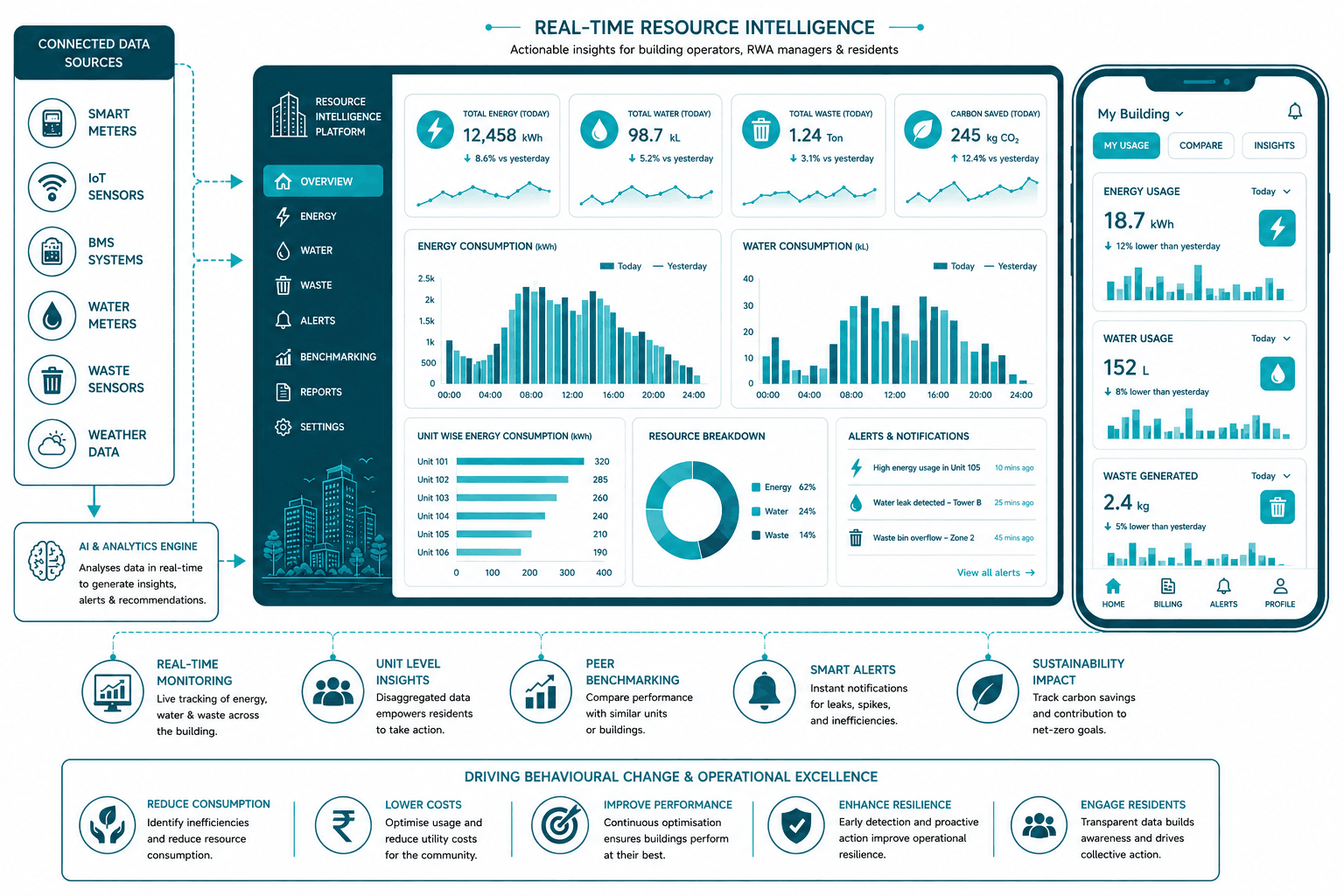
This convergence of IoT, data analytics, and user-facing platforms is where smart building technology is heading in India. The infrastructure smart meters, connected appliances, building automation systems is being installed in new premium developments today. The opportunity is to make that data visible, actionable, and meaningful for the people who live and work in those buildings.
Platforms like DeJoule by SmartJoules are already operationalising this in India using AI and IoT to continuously optimise energy use across HVAC and building systems, with minute-wise automated data logging and real-time alerts, bringing the promise of intelligent building management into practical, everyday operation.
The Indian Opportunity: Why Now
India is building the equivalent of a new Chicago every year in terms of floor area. The decisions being made right now by developers, RWA managers, architects, and building owners will lock in energy and resource consumption patterns for 30–50 years.
Smart water metering, energy auditing and efficiency retrofits, net-zero sewage treatment, construction waste-based materials, and integrated building intelligence platforms are all commercially available and being deployed in Indian projects today.
The challenge is integration. Most buildings access these solutions in isolation a solar panel here, a water meter there without a coherent framework for measuring, managing, and optimising performance across all resource streams simultaneously.
The net-zero buildings that will set the standard for Indian real estate in the next decade will be the ones that treat energy, water, waste, and materials not as separate problems, but as an interconnected system and invest in the intelligence layer to manage that system continuously.
Net-zero buildings are not a single technology. They are an integrated outcome achieved through the combination of thoughtful design, high-performance materials, efficient systems, renewable generation, smart water management, waste circularity, and digital intelligence.
For developers, owners and facility management teams in India, the path to net-zero is not about a single large investment. It begins with measurement understanding where energy, water, and resources are actually going. It continues through targeted interventions in the systems with the highest impact. And it is sustained by the data infrastructure that makes performance visible and accountable over time.
Image Disclaimer: All images used in this article are for illustrative and educational purposes only. They represent concepts, design approaches, and system relationships. Actual project designs, configurations, and performance outcomes may vary based on site conditions and implementation practices.
References
- Attia, S., Lioure, R., & Declaude, Q. (2020). Future trends and main concepts of adaptive facade systems. Energy Science & Engineering, 8(9), 1–18.
- Hannan, M. A. et al. (2026). Digital twin enabling net-zero energy building integrated grid digital transformation. Energy Strategy Reviews, 64, 102148.